Selecting the right fishing hook size is one of the most important decisions anglers make. The correct hook improves bait presentation, increases hook-up rates, and helps land fish more effectively. With hook sizes ranging from tiny trout hooks to large offshore game hooks, understanding how the sizing system works can seem confusing at first. This guide explains fishing hook sizes, common hook types, recommended sizes for different fish species, and practical tips to help you choose the right hook for every fishing trip.
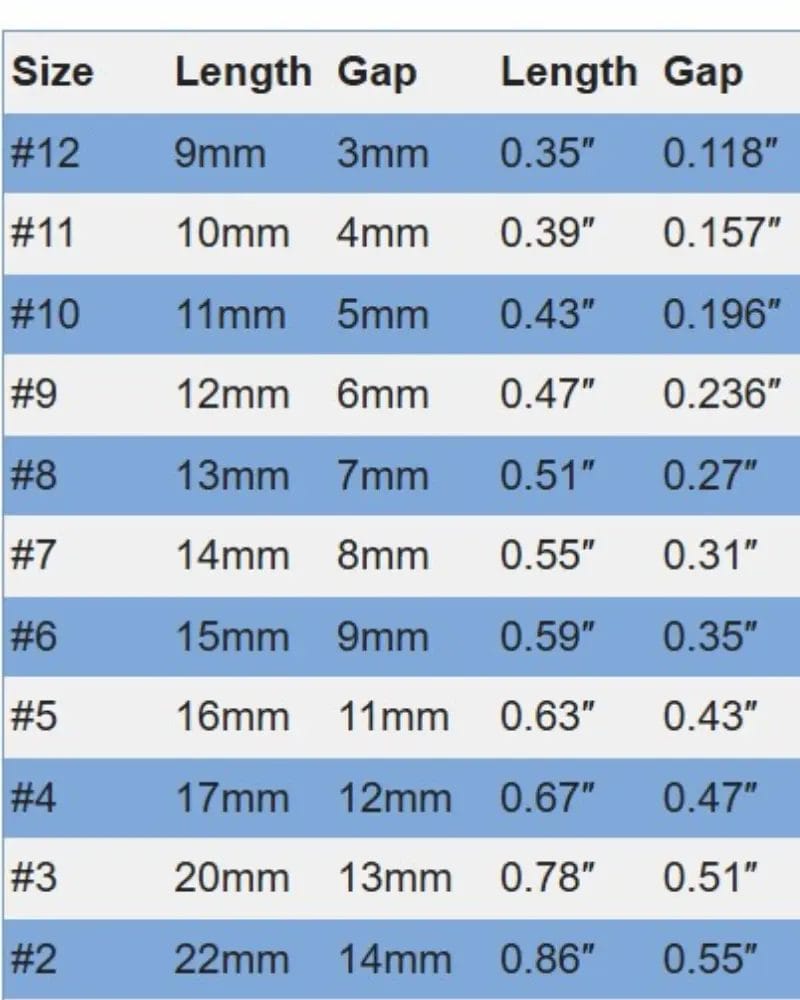
Hook Size Chart
| Size | Length | Gap | Length | Gap |
| #12 | 9mm | 3mm | 0.35″ | 0.118″ |
| #11 | 10mm | 4mm | 0.39″ | 0.157″ |
| #10 | 11mm | 5mm | 0.43″ | 0.196″ |
| #9 | 12mm | 6mm | 0.47″ | 0.236″ |
| #8 | 13mm | 7mm | 0.51″ | 0.27″ |
| #7 | 14mm | 8mm | 0.55″ | 0.31″ |
| #6 | 15mm | 9mm | 0.59″ | 0.35″ |
| #5 | 16mm | 11mm | 0.63″ | 0.43″ |
| #4 | 17mm | 12mm | 0.67″ | 0.47″ |
| #3 | 20mm | 13mm | 0.78″ | 0.51″ |
| #2 | 22mm | 14mm | 0.86″ | 0.55″ |
| #1 | 25mm | 15mm | 0.98″ | 0.59″ |
| 1/0 | 34mm | 16mm | 1.33″ | 0.63″ |
| 2/0 | 39mm | 17mm | 1.53″ | 0.67″ |
| 3/0 | 42mm | 18mm | 1.65″ | 0.70″ |
| 4/0 | 47mm | 19mm | 1.85″ | 0.74″ |
| 5/0 | 52mm | 21mm | 2.04″ | 0.82″ |
| 6/0 | 59mm | 23mm | 2.32″ | 0.90″ |
| 7/0 | 65mm | 25mm | 2.56″ | 0.98″ |
| 8/0 | 72mm | 28mm | 2.83″ | 1.10″ |
| 9/0 | 78mm | 31mm | 3.07″ | 1.22″ |
| 10/0 | 90mm | 37mm | 3.54″ | 1.45″ |
Understanding Fishing Hook Sizes
Fishing hooks are commonly available from size 32 (very small) to 20/0 (very large). Standard numbered hooks become smaller as the number increases (for example, #12 is smaller than #4). Once the sizing reaches #1, the system changes to “aught” sizes (1/0, 2/0, 3/0, and so on), where the hook becomes larger as the number increases.
A smaller hook improves bait presentation but may struggle with larger fish, while a bigger hook increases strength but can deter bites. Finding the right balance depends on your target species, fishing technique, and bait type. By considering these factors, you can improve your chances of success on the water.
How Fishing Hook Sizes Work
Fishing hook sizes follow two different numbering systems.
- Standard sizes (#32 to #1): The larger the number, the smaller the hook.
- Aught sizes (1/0 to 20/0): The larger the number, the larger the hook.
For example:
| Hook Size | Relative Size |
|---|---|
| #12 | Very small |
| #8 | Small |
| #4 | Medium |
| #1 | Large |
| 1/0 | Larger |
| 5/0 | Very large |
| 10/0 | Extra large |
Understanding this numbering system makes choosing hooks much easier.
Fishing Hook Size Guide by Fish Species
Different fish require different hook sizes based on their mouth size and feeding habits.
| Fish Species | Recommended Hook Size |
|---|---|
| Bluegill | #10–#6 |
| Crappie | #8–#4 |
| Trout | #12–#6 |
| Perch | #8–#4 |
| Bass | #4–2/0 |
| Walleye | #6–#2 |
| Catfish | 1/0–8/0 |
| Pike | 2/0–6/0 |
| Salmon | 1/0–5/0 |
| Tuna | 6/0–12/0 |
Actual hook size may vary depending on bait and fishing conditions.
Common Fishing Hook Sizes and Their Uses
Small Hooks (#32 to #10)
Ideal for:
- Trout
- Bluegill
- Crappie
- Panfish
These hooks present live bait naturally and work well with worms, insects, and small artificial flies.
Medium Hooks (#8 to #1)
Commonly used for:
- Bass
- Walleye
- Perch
- Small catfish
They provide an excellent balance between strength and natural presentation.
Large Hooks (1/0–5/0)
Best suited for:
- Pike
- Large bass
- Salmon
- Catfish
These hooks handle larger bait while providing greater holding power.
Extra Large Hooks (6/0 and Above)
Designed for:
- Tuna
- Shark
- Marlin
- Offshore saltwater fishing
These heavy-duty hooks are built for powerful fish and require appropriately matched tackle.
Common Types of Fishing Hooks
Different hook designs serve different fishing techniques.
J-Hooks
The traditional hook used with live bait and many freshwater techniques.
Circle Hooks
Designed to hook fish in the corner of the mouth, reducing deep hooking and improving catch-and-release survival.
Octopus Hooks
Popular for live bait presentations because of their short shank and wide gap.
Treble Hooks
Contain three hook points and are commonly attached to crankbaits, spoons, and other artificial lures.
Weedless Hooks
Feature a weed guard that helps reduce snagging around vegetation and underwater cover.
Choosing the Right Hook for Different Fishing Techniques
Different fishing techniques require specific hook sizes to maximize success. In fly fishing, tiny hooks (sizes 20-32) create lifelike bait movement but can be challenging to handle. Bait fishing relies on medium to large hooks, balancing bait size and fish type, yet choosing the wrong size may reduce bites.
Lure fishing uses treble or single hooks, with size depending on the lure’s design. While larger hooks improve durability, they can affect lure action. Understanding these tradeoffs helps you select the best hook for your method.
The best hook size depends not only on the fish but also on your fishing method.
- Live bait fishing: Match the hook to the size of the bait.
- Soft plastic lures: Use hooks designed specifically for plastic baits.
- Fly fishing: Choose small hooks that imitate natural insects.
- Saltwater fishing: Use corrosion-resistant hooks designed for larger species.
- Catch and release: Circle hooks often reduce injury to fish.
Factors That Affect Hook Selection
Several factors influence the ideal hook size:
- Target fish species
- Bait size
- Fishing location
- Freshwater or saltwater
- Hook strength
- Wire thickness
- Fishing technique
- Catch-and-release versus keeping fish
Balancing these factors improves both hook-up rates and fish handling.
Different Hook Size Systems
Hook sizes can be confusing, as different hook manufacturers use various sizing systems. To understand hook sizes better, it’s important to know the main components of a hook. The shank, bend, and point are integral to a hook’s size and determine how it will fit into a fish’s mouth.
Hook sizes based on a number scale are the most popular, with smaller numbers indicating larger hooks. However, there is no international standard for hook sizes, so it’s essential to compare hooks from different manufacturers. Some manufacturers also use descriptive terms such as Fine Wire, Heavy Duty, Wide Gap, or Extra Wide Gap (EWG) alongside hook sizes. Because there is no universal manufacturing standard, hooks labeled with the same size may vary slightly between brands.
It’s important to note that the sizing system only indicates the gap between the shank and point and doesn’t necessarily relate to the overall size of the hook. It’s worth checking the sizing guide of your chosen manufacturer and experimenting with different sizes to find the best fit for your target fish species.
Tips for Choosing the Right Fishing Hook
- Match the hook to the size of your bait.
- Choose the smallest hook that can securely hold the bait.
- Consider the fish’s mouth size.
- Use corrosion-resistant hooks for saltwater.
- Replace hooks that become dull or bent.
- Carry multiple hook sizes for changing fishing conditions.
Conclusion
Choosing the right fishing hook size is about more than simply selecting a number. The ideal hook depends on your target species, bait, fishing technique, and water conditions. By understanding both the standard and aught sizing systems and matching your hook to the fish you’re pursuing, you’ll improve hook-up rates, reduce missed strikes, and enjoy a more successful day on the water. Keeping a variety of hook sizes in your tackle box ensures you’re prepared for changing fishing conditions and different species.
FAQs
How do I choose the right fishing hook size?
Choosing the right hook size depends on the fish species, bait type, and fishing technique. Smaller hooks (sizes 32-12) work best for small fish, while larger hooks (1-20/0) are ideal for big game fishing. A hook size chart can help match the right hook to your needs.
Are hook sizes the same for all brands?
No, hook sizes can vary slightly between brands. While the general numbering system is similar, some manufacturers may have slight differences in their sizing. It’s always best to check the brand’s specific size chart before purchasing hooks.
What does 1/0 mean on a fishing hook?
After standard hook sizes reach #1, manufacturers switch to aught (“/0”) sizing. In this system, 1/0 is larger than #1, and the hook becomes larger as the aught number increases.
Does a bigger hook catch bigger fish?
Not always. The best hook size depends on the fish species, bait, and fishing technique. Using a hook that’s too large may actually reduce bites from cautious fish.
Can I use the same hook size for freshwater and saltwater fishing?
The size may be similar, but saltwater hooks should be made from corrosion-resistant materials and designed to handle stronger fish.
How do I know when to replace a fishing hook?
Replace a hook if it becomes dull, bent, rusted, or damaged. A sharp hook penetrates more easily and improves your chances of landing fish.