If you’ve ever shopped for shoes in different countries, you know how tricky finding the right size can be—especially with EU and UK sizing. Understanding size differences is crucial when shopping globally, and this guide will help you easily convert between EU and UK shoe sizes, avoiding any confusion.
Men’s EU to UK Shoes
| EU | UK | Foot length (cm) |
|---|---|---|
| 39 | 5.5 | 24.6 |
| 40 | 6.5 | 25 |
| 41 | 7 | 25.4 |
| 42 | 8 | 26.3 |
| 43 | 9 | 27.2 |
| 44 | 9.5 | 27.6 |
| 45 | 10 | 28 |
| 46 | 11 | 28.9 |
| 47 | 12 | 29.8 |
Women’s EU to UK Shoes
| EU | UK | US | Foot length (cm) |
|---|---|---|---|
| 35 | 2 | 4 | 21.2 |
| 36 | 3 | 5 | 22.1 |
| 37 | 4 | 5.5 | 22.9 |
| 38 | 5 | 6.5 | 23.7 |
| 39 | 5.5 | 7 | 24.6 |
| 40 | 6.5 | 8 | 25 |
| 41 | 7 | 8.5 | 25.4 |
| 42 | 8 | 9.5 | 26.3 |
| 43 | 9 | 10 | 27.2 |
What’s the Difference Between EU and UK Shoe Sizes?
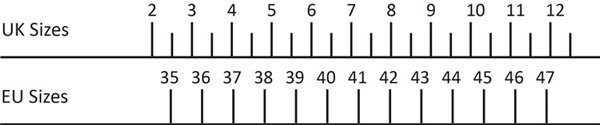
While both Europe and the UK have robust shoe sizing systems, the two are structured differently, causing confusion for many shoppers. The EU system uses a simple metric-based approach, where sizes increase by whole numbers (and sometimes half sizes) based on the length of the foot in centimeters. This system is straightforward and applies universally across Europe, making it relatively easy to follow.
On the other hand, the UK shoe sizing system is based on an inch measurement. It starts at size 0, with each full size representing a ⅓-inch increase in length. Unlike the EU system, UK sizing has a unique starting point and includes half sizes more consistently. This method stems from traditional UK measurements and is widely used across the country.
The main difference between the two systems lies in their increments and starting points. EU sizes typically don’t include half sizes as frequently as UK sizes, leading to gaps in precision. For example, an EU size 42 is roughly a UK size 8, but depending on the shoe brand, the exact fit may differ slightly.
Balancing these two systems can be tricky because there isn’t a perfect conversion method. The EU’s reliance on centimeters makes it more consistent across different shoe brands, while the UK’s inch-based system allows for finer adjustments with half sizes. However, this flexibility can also create confusion, especially when brands interpret sizes differently.
When deciding between EU and UK shoe sizes, it’s important to consider these differences. The challenge is in finding a size that fits comfortably while accounting for variations in both systems. Choosing the right size depends on understanding how each system works, and recognizing that different brands may apply these systems in their own way.
How to Convert EU Shoe Sizes to UK Sizes
Converting between EU and UK shoe sizes isn’t as complicated as it seems, and with the right information, you can make accurate comparisons. Here’s a simple step-by-step process to guide you:
Find Your EU Size: Begin by identifying your EU shoe size. This is typically a whole number.
Subtract Two for Men or Three for Women: To convert to UK sizes, subtract two from the EU size for men and three for women. For example, an EU size 42 for men would be a UK size 10, while a size 42 for women would be a UK size 9.
Consider Half Sizes: Keep in mind that some sizes may vary slightly. While the general rule works well, some brands or styles may offer half sizes, requiring you to round up or down depending on the fit you prefer.
It’s important to note that EU and UK sizing systems are based on different measurements, which is why there isn’t a perfect 1:1 match. The EU system uses a metric-based approach, while the UK system is rooted in inches. This difference creates slight variations, particularly between sizes. Additionally, factors like shoe brand, design, and even regional variations can affect the exact fit, so it’s always best to try on shoes when possible.
FAQs
How do I know if I should go up or down a size when converting between EU and UK shoe sizes?
When converting between EU and UK sizes, it’s best to follow general conversion charts, but size differences between brands can make this tricky. As a rule of thumb, subtract 2 sizes for men and 3 sizes for women when converting from EU to UK. However, if you’re between sizes or unsure, consider going up half a size to ensure comfort. It’s also a good idea to check each brand’s specific sizing guide, as fit can vary slightly.
Why don’t EU and UK shoe sizes match exactly?
EU and UK shoe sizes don’t match exactly because they are based on different measurement systems. The EU system uses a metric-based approach, measuring in centimeters, while the UK system is based on inches. Additionally, the starting points and increments differ, creating gaps when converting between them. This makes finding a direct 1:1 match difficult, especially when considering differences in shoe brands and styles.
Can I rely on online sizing charts to ensure a perfect fit?
Sizing charts are a great starting point, but they aren’t always 100% reliable due to variations in how different brands interpret sizes. Foot shape, shoe design, and materials can also affect fit. To improve accuracy, measure your feet and compare them to the brand’s specific chart rather than using a general size conversion. When shopping internationally, always review return policies in case you need to exchange sizes.